

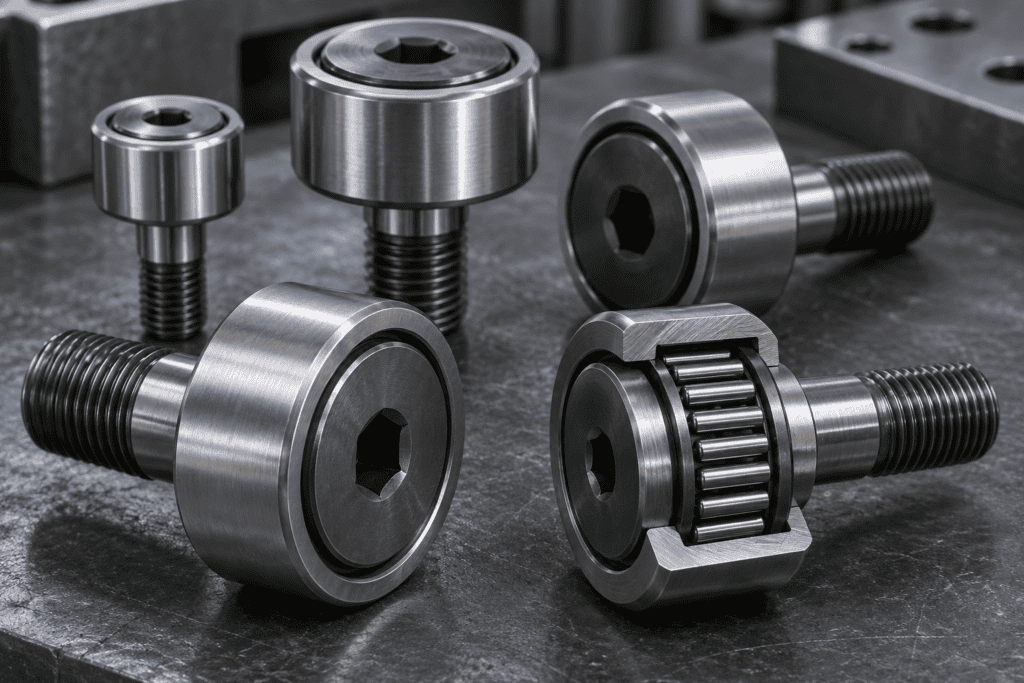
A cam follower is a needle-roller bearing with a thick-walled outer ring that rolls directly against a cam profile, track or guide rail, converting rotary motion into precise linear motion in packaging machines, conveyors, printing presses and automated assembly lines. Two families cover most designs: stud type, which threads straight into the machine frame, and yoke type, which mounts on a fixed pin. Choosing between them—and between caged, full-complement, sealed or crowned variants—comes down to three numbers: roller diameter, dynamic load rating and limiting speed.
Unlike a standard ball bearing that sits inside a housing, a cam follower works exposed. Its outer ring doubles as the rolling contact surface, so ring thickness, roller complement and sealing decide how long it survives against shock loads, misalignment and contamination.
Cam Follower Anatomy: What the Part Numbers Hide
Every stud-type cam follower combines four functional parts:
- Stud: the threaded mounting shank. On a metric KR16, the stud is 6 mm in diameter; inch-series followers use UNF threads such as 1 1/4″-12 on heavy-duty sizes.
- Roller (outer ring): the thick-walled ring that touches the cam. The KR16 runs a 16 mm roller diameter with an 11 mm roller width.
- Needle roller complement: caged needles for speed, or a full complement of loose needles for load.
- Seals: suffix PP or 2RS indicates rubber-sealed; open versions run faster but need external protection.
The full stud cam follower range covers more than 3,300 metric and inch designs, and the complementary yoke cam follower range adds over 1,600 pin-mounted types, so almost any cam geometry has a matching follower.
Stud Type vs Yoke Type: Which Mounting Fits Your Machine
Stud type followers thread directly into a tapped hole in the frame and lock with a nut. Installation is fast, adjustment is easy, and a hex hole or screwdriver slot in the stud end allows tightening from the front. They are the default choice for packaging lines, indexing tables and light-to-medium cam drives.
Yoke type followers press onto a stationary pin and are retained by the pin shoulders or circlips. Because there is no threaded stud to bend, yoke types tolerate heavier shock loads and run more quietly—common in forklift masts, machine-tool camboxes and large conveyor transfer units.
Rule of thumb: if the machine frame can be tapped and loads are moderate, choose stud type; if shock loads are high or space forbids a long threaded shank, choose yoke type.
Cylindrical vs Crowned Rollers
A cylindrical roller rolls true only when the cam face is exactly parallel to the follower axis. Any misalignment concentrates the load on one roller edge and shortens life. A crowned (barrel-profile) roller, such as on the sealed CF3FBUUR with its 10 mm roller diameter and 1,200 N dynamic rating, relieves edge stress by several degrees of angular misalignment.
Specify crowned rollers whenever the cam and follower cannot be aligned to under 0.5°, or when the follower runs on a flat track rather than a contoured cam.
Caged vs Full Complement: The Load-Speed Trade-Off
The internal construction changes the numbers dramatically. Compare two same-size 16 mm sealed followers from the same series:
| Model | Construction | Roller dia. | Dynamic load (Cr) | Limiting speed |
|---|---|---|---|---|
| KR16-PP | Caged needle rollers | 16 mm | 3,150 N | 14,000 rpm |
| KRV16-PP | Full complement | 16 mm | 4,900 N | 3,800 rpm |
Removing the cage and filling every gap with a needle lifts dynamic capacity by 56%—but without a cage to guide and separate them, the needles rub at high speed and the rating drops 73% to 3,800 rpm. Full-complement followers (KRV series) are therefore the choice for slow, heavy indexing cams; caged followers (KR series) for fast continuous rotation.
Sealed vs Unsealed
The unsealed KR16 reaches the same 14,000 rpm limit as the sealed KR16-PP, but only the sealed version keeps grease in and paper dust, coolant and washdown spray out. In food packaging and printing environments, sealed (PP) variants routinely outlast open ones by a factor of two or more. Open versions make sense only inside oil-bath gearboxes or sealed camboxes where the follower is lubricated externally.
How to Select: A Four-Step Checklist
- Size the roller to the cam load. Match the required dynamic load rating C to the equivalent radial load P with C/P ≥ 5 for cam duty. A KR16-PP at 3,150 N suits loads up to roughly 630 N; step up to the KR22-PP (22 mm roller, 4,550 N) for heavier tracks.
- Check the speed. Convert cam rpm × follower diameter to surface speed; stay under the published limiting rpm. At 16 mm, the KR family allows 14,000 rpm; full-complement KRV units top out near 3,800 rpm.
- Pick the seal for the environment. Sealed for dusty or wet machines, open for oil-lubricated enclosures.
- Confirm stud strength and thread. The stud sees the full radial load as bending stress; when in doubt, move to the next stud diameter (M6 → M8 → M10) or switch to a yoke type on a through pin.
Representative metric stud types from the current catalog:
| Model | Roller (D × B) | Stud | Cr | Limiting speed | Seal | Price |
|---|---|---|---|---|---|---|
| KR16-PP | 16 × 11 mm | M6 × 8 mm | 3,150 N | 14,000 rpm | Sealed | $11.58 |
| KR19-PP | 19 × 11 mm | M8 × 10 mm | 3,500 N | 11,000 rpm | Sealed | $12.00 |
| KR22-PP | 22 × 12 mm | M10 × 12 mm | 4,550 N | 8,000 rpm | Sealed | $12.75 |
| KRV16-PP | 16 × 11 mm | M6 × 16 mm | 4,900 N | 3,800 rpm | Sealed | $12.15 |
Our Recommendation
For most general machinery, a sealed caged stud follower such as the KR16-PP or KR19-PP is the right default: fast enough for 10,000+ rpm cams, sealed against dust, and inexpensive to stock as a spare. Move to a full-complement KRV variant only when the duty is slow and genuinely heavy, and to a crowned CF-series roller whenever alignment cannot be guaranteed. Verify the stud bending margin before downsizing the thread.
FAQ
What is the difference between a cam follower and a track roller?
Functionally they are the same bearing. “Cam follower” emphasizes running against a rotating cam profile, while “track roller” emphasizes running along a linear guide or track. Both are available in stud and yoke mounting, and manufacturers—FIJ included—often list them under both names.
Can I lubricate a sealed cam follower?
Most sealed cam followers arrive pre-greased and sealed for life. Some designs add a lubrication hole through the stud for relubrication; check the suffix and product drawing. If your application exceeds the grease life, choose a type with the relube hole or increase the bore size to extend intervals.
Why did my cam follower fail at the stud?
Stud fracture is almost always under-sizing, not a bearing defect: the full cam reaction force bends the threaded shank every revolution. Recalculate the bending stress with the actual radial load and shock factor, then move up one stud diameter (for example from M6 to M8) or switch to a yoke type that transfers load into a supported pin instead of a cantilevered stud.