

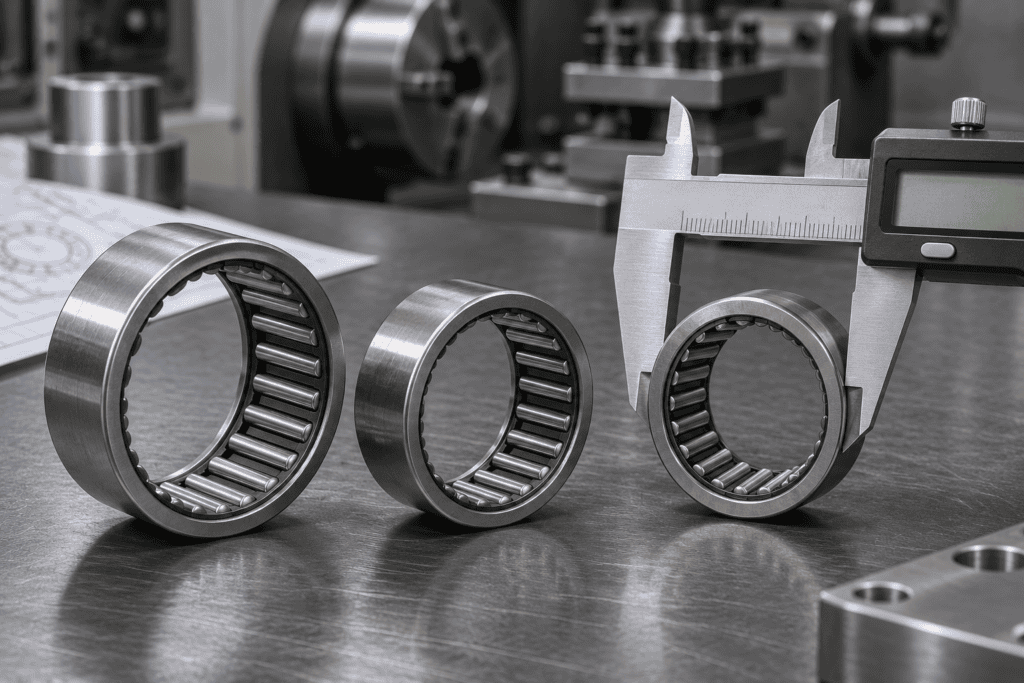
NA, NK and NKI are the three most common prefixes for machined needle roller bearings with a solid outer ring, and they answer one question in different ways: does the bearing come with an inner ring, and how much radial space does it need? NA is the heavy series with an inner ring; NK is the light series without an inner ring, designed to run directly on the shaft; NKI is the light series with an inner ring. The numbers after the prefix follow different rules for each family—which is exactly where most ordering mistakes happen.
All three families share the same anatomy: a precision-machined steel outer ring, a steel cage and a full set of needle rollers, giving very high radial load capacity in a small cross-section. What changes between the prefixes is the inner ring and the dimension series, and those two choices decide whether your shaft must be hardened, how much housing space you need, and how much load the assembly can carry. FIJ’s machined needle roller range alone covers more than 1,000 SKUs across these families, so a five-minute read of the designation saves a costly return shipment.
NA, NK and NKI at a Glance
| Prefix | Inner ring | Dimension series | How the size code reads | Example |
|---|---|---|---|---|
| NA | Yes | Heavy (48 / 49 / 69) | Two-digit bore code from the ISO table | NA4904 = 20 mm bore |
| NK | No | Light | Roller-set bore (Fw) / width, both in mm | NK20/20 = Fw 20 mm, 20 mm wide |
| NKI | Yes | Light | Shaft bore / width, both in mm | NKI20/20 = 20 mm bore, 20 mm wide |
Two relatives complete the picture: RNA is the heavy series without an inner ring (the NA family stripped of its ring), and NKIS is the light series with an inner ring in heavier section than NKI. If a designation starts with R, the bearing has no inner ring—full stop.
NA Series: With Inner Ring, Heavy Section
NA bearings combine a thick machined outer ring with a matching inner ring, so the shaft needs no special hardening or grinding. That makes them the default choice for gearboxes, agricultural machinery and construction equipment, where shafts are often standard steel and loads arrive with shock. Take the NA4904-XL: a 20 mm bore, 37 mm outside diameter and 17 mm width, rated 5,332 lbf dynamic and 5,738 lbf static, with a limiting speed of 16,900 rpm at only 75.2 g.
The 48 dimension series scales the same logic up to large shafts. The NA4822-XL runs a 110 mm bore against a 140 mm outside diameter in a 30 mm width, carrying 23,850 lbf dynamic and 48,600 lbf static—over 1 kg of precisely machined steel built for conveyor, compressor and mining duty.
NK Series: No Inner Ring, Smallest Envelope
Remove the inner ring and the whole bearing shrinks around the shaft. The NK20/20-XL needs only a 28 mm housing bore for a 20 mm shaft, where the NA4904 needs 37 mm—nine millimetres of radial space saved, and at 33.9 g it weighs less than half of the NA equivalent. Freed from the inner ring’s mass, it also spins faster: 21,100 rpm limiting speed versus 16,900 rpm for the NA4904.
The trade-off is that the needles run directly on the shaft, so the shaft itself becomes the inner raceway. That demands a hardened and ground surface: the NK20/20’s roller-set bore tolerance is just 0.02 to 0.033 mm. If your shaft cannot meet that, press on a matched IR inner ring—or skip the problem and order the NKI.
NKI Series: With Inner Ring, Light Section
NKI splits the difference: the light-series outer ring of the NK, plus an inner ring so the shaft stays standard. The NKI20/20-XL fits a 20 mm shaft in a 32 mm housing bore—5 mm smaller than the NA4904—while its extra width (20 mm versus 17 mm) actually lifts the static rating to 6,862 lbf against the NA’s 5,738 lbf. At 61 g and 18,500 rpm, it is the compact all-rounder of the three families.
Same 20 mm Shaft, Three Different Bearings
Put the families side by side on one shaft size and the designation logic becomes concrete:
| Bearing | Inner ring | Bore | OD | Width | Dyn. load (Cr) | Static load (Cor) | Limiting speed | Weight |
|---|---|---|---|---|---|---|---|---|
| NK20/20-XL | No | 20 mm (Fw) | 28 mm | 20 mm | 4,185 lbf | 5,355 lbf | 21,100 rpm | 33.9 g |
| NKI20/20-XL | Yes | 20 mm | 32 mm | 20 mm | 4,815 lbf | 6,862 lbf | 18,500 rpm | 61 g |
| NA4904-XL | Yes | 20 mm | 37 mm | 17 mm | 5,332 lbf | 5,738 lbf | 16,900 rpm | 75.2 g |
| NA6904-XL | Yes | 20 mm | 37 mm | 30 mm | 9,112 lbf | 11,475 lbf | 16,900 rpm | 141 g |
| NA4904-2RSR-XL | Yes, sealed | 20 mm | 37 mm | 18 mm | 4,388 lbf | 4,478 lbf | 10,100 rpm | 80 g |
Three lessons fall out of the table. First, dropping the inner ring (NK) buys the smallest envelope and the highest speed. Second, the double-row NA69 nearly doubles dynamic capacity over the NA49 in the same 37 mm bore—9,112 lbf against 5,332 lbf—for the price of 13 extra millimetres of width. Third, sealing is never free: the -2RSR version trades 40% of its speed rating (16,900 down to 10,100 rpm) for dust exclusion and maintenance-free grease.
What the Suffixes Tell You
- -2RSR / -RSR: lip seals on both sides or one side. Sealed units arrive greased for life; expect roughly 40% lower limiting speed than the open version.
- ZW: double-row construction, as on the NA6907-ZW and larger 69-series sizes.
- -TV: glass-fibre reinforced polyamide cage (common on small NK sizes such as the NK10/12-TV), quieter and lighter than a steel cage, limited to the standard -20 °C to +110 °C operating range.
- -XL: the manufacturer’s optimized internal geometry—improved raceway profile and roller guidance for higher load ratings in the same envelope.
How to Choose: A Simple Rule
Start from the shaft, not the catalog. If the shaft can be hardened and ground to raceway quality and every millimetre of housing space counts, choose NK—nothing else packs as much load into as little space at as high a speed. If the shaft must stay standard, choose NKI when space is tight and NA when loads are heavy or shock-prone; the NA’s thicker rings and wider range of sealed and double-row variants cover the hardest duty. Need it sealed and maintenance-free? Take the -2RSR variant and budget for the lower speed rating. The full machined needle roller bearing range lists every NA, NK, NKI, RNA and NKIS size with its load and speed data for a direct comparison.
FAQ
Can an NK bearing run directly on any steel shaft?
No. Without an inner ring, the needles roll straight on the shaft, so the shaft surface must be hardened and ground to raceway standard—typically a surface hardness around HRC 58 and a finish comparable to a bearing raceway, with tolerances in the hundredths of a millimetre (the NK20/20’s roller-set bore tolerance is 0.02 to 0.033 mm). On a standard soft shaft, press on a matched IR inner ring or choose the NKI version instead.
Are NKI and NA bearings interchangeable for the same bore?
No. An NKI20/20 and an NA4904 both fit a 20 mm shaft, but the NKI is 32 mm outside and 20 mm wide while the NA4904 is 37 mm outside and 17 mm wide—different housings, different shoulders. The NA also belongs to the heavy dimension series, so its rings are thicker and better suited to shock loads. Always match the full designation, not just the bore.
What does the number after the slash mean in NK20/20?
It is the bearing width in millimetres. NK and NKI designations read as bore (or roller-set bore Fw for NK) followed by width: NK20/20 is a 20 mm roller-set bore, 20 mm wide; NKI20/16 would be a 20 mm shaft bore, 16 mm wide. NA designations instead use the ISO two-digit bore code, where NA4904 means the 49 dimension series with code 04 for a 20 mm bore.