
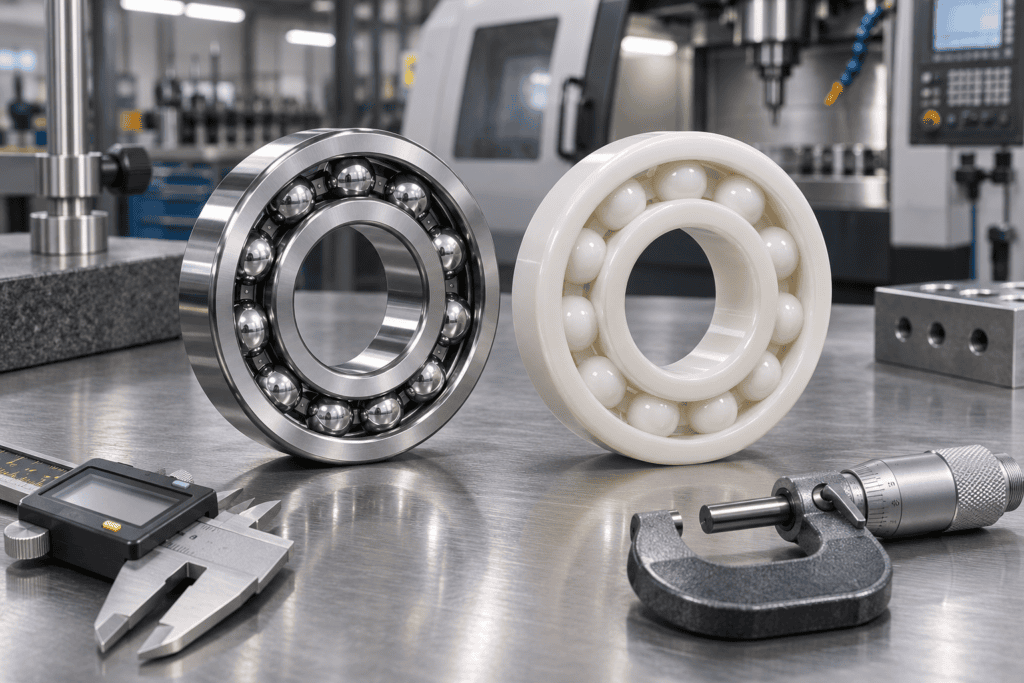
If you are weighing ceramic bearings against standard steel bearings, the short answer is this: full ceramic bearings win on corrosion resistance, temperature range, electrical insulation and weight, but they carry roughly one-third of the dynamic load of an equivalent chrome steel bearing and cost about four times more. Steel remains the default for load-carrying duty; ceramic earns its price where steel fails from heat, chemicals, magnetism or current passage — and hybrid constructions close most of the gap at a mid-range price.
At FIJ Bearings, both constructions are stocked side by side in the same dimension series, which makes the comparison unusually clean. The numbers below come straight from the current catalog data — same bore sizes, real load ratings, real 2026 list prices — so you can match them directly against your application requirements.
Three Constructions, Not Two
Buyers usually frame this as “ceramic vs steel,” but the market actually offers three distinct builds:
- Chrome steel (standard): hardened raceways and balls, highest load capacity per size, lowest cost. The reference point for everything else.
- Full ceramic: rings and balls both in ceramic — typically Zirconia (ZrO2), Silicon Nitride (Si3N4) or Silicon Carbide (SiC). Non-magnetic, electrically insulating, corrosion-proof, and able to run without lubrication.
- Hybrid ceramic: chrome steel rings with Silicon Nitride balls. Keeps near-steel load capacity while gaining most of the ceramic speed, weight and insulation benefits. FIJ stocks hybrid deep groove types such as the 6200/HC5C3 hybrid ceramic bearing.
Same Size, Real Numbers: 10 mm Bore Compared
Dimension-for-dimension comparison is the only honest way to look at price versus performance. Here is what the catalog actually lists for a 10 mm bore in each construction:
| Specification | 6000 JEM (chrome steel) | 6000 2RS (full ceramic) |
|---|---|---|
| Bore × OD × width | 10 × 26 × 8 mm | 10 × 26 × 8 mm |
| Dynamic load rating (Cr) | 1,023 lbf | 307 lbf |
| Static load rating (Cor) | 438 lbf | 132 lbf |
| Max speed | 31,000 rpm | 21,700 rpm |
| Weight | 19 g | 14.25 g |
| Sealing | Open | PTFE seals (2RS) |
| List price | $2.30 | $9.85 |
Two facts stand out. First, the full ceramic bearing is not the load champion — its 307 lbf dynamic rating is about 30% of the steel equivalent, because ceramic rings cannot be loaded like hardened bearing steel. Second, you are paying roughly 4.3× the price for properties steel cannot offer at any price: the full ceramic line operates from -176 °F to 428 °F, runs without lubricant, and will never rust, spark or conduct current.
Where Full Ceramic Bearings Justify the Price
Specify full ceramic when at least one of these conditions is hard requirements rather than preferences:
- Corrosive or washdown environments. Sealed full ceramic types like the 6000 2RS ceramic bearing shrug off chemicals that pit even stainless steel.
- Non-magnetic or insulating duty. MRI machines, satellite gyroscopes and measurement instruments use ceramic because steel balls distort fields and conduct stray currents.
- Extreme temperatures. The -176 to 428 °F operating window covers cryogenic pumps, ovens and sterilization cycles where grease and steel both give up.
Within the ceramic ball bearing range, larger cross-sections recover meaningful capacity: the 6300 2RS full ceramic lifts the dynamic rating to 547 lbf at 39.75 g, still at a fraction of steel weight.
Where Steel — or Hybrid — Still Wins
For plain radial load at normal temperatures, chrome steel remains the rational choice. The 6300 JEM steel bearing delivers a 1,821 lbf dynamic rating and 776 lbf static rating at $4.71; no full ceramic in the same envelope comes close on load per dollar.
When speed is the real problem — spindles, turbo machinery, dental handpieces — the hybrid construction is the technical sweet spot. The 6200/HC5C3 hybrid carries the same 1,140 lbf dynamic rating as its all-steel counterpart in the same envelope, with a 63,000 r/min reference speed and a 40,000 rpm limit, because the lightweight Silicon Nitride balls cut centrifugal load and internal friction. At $8.71 it sits between steel and full ceramic in price, and it is usually the right answer for high-speed electric motors and machine tool spindles.
The 2026 Price Picture
Across the current catalog, the spread is consistent: full ceramic runs 4–5× the price of the equivalent chrome steel bearing (6000 2RS ceramic at $9.85 versus 6000 JEM steel at $2.30), and hybrids land in between ($8.71 for the 6200/HC5C3 against $1.81 for the steel 6200 JEM). Two practical consequences follow:
- Never default to ceramic “just in case.” Pay the premium only where corrosion, magnetism, insulation or temperature genuinely eliminates steel.
- For mixed requirements — load plus speed — price the hybrid first. It often solves the application at roughly half the cost penalty of going fully ceramic.
Bottom Line
Choose chrome steel for maximum load capacity and minimum cost — it is the right bearing for the majority of industrial positions. Choose full ceramic when the environment is chemically hostile, extremely hot or cold, magnetic-field-sensitive or electrically live, and accept roughly one-third of the load capacity and 4–5× the price. Choose hybrid ceramic for high-speed duty where you cannot sacrifice load rating. Match the construction to the failure mode you are actually fighting, and the price difference stops looking arbitrary.
FAQ
Are ceramic bearings worth 4–5 times the price of steel?
Only when steel demonstrably fails: corrosion, extreme temperature, magnetic interference or electrical conduction. For ordinary load-and-speed duty, the extra cost buys nothing measurable.
Do full ceramic bearings need lubrication?
No. The full ceramic range is listed to run without lubricant thanks to the low-friction ceramic-to-ceramic contact, which also suits cleanroom and food-adjacent positions where grease is contamination. Hybrids still require lubrication.
Are full ceramic bearings stronger than steel bearings?
No — they are harder and more corrosion-resistant, but more brittle under impact and much lower in load capacity. The 6000 2RS ceramic is rated at 307 lbf dynamic versus 1,023 lbf for the steel 6000 JEM in the same envelope. Shock loads are the classic failure mode for full ceramic rings.