
If you are specifying bearings for food processing or medical equipment, the short answer is this: choose 440C stainless steel when the bearing must carry real radial loads and hold precision, and choose 304 or 316 when the priority is maximum corrosion resistance against washdown chemicals, saline or bodily fluids, with lighter loads. The three grades are not interchangeable, and picking the wrong one is the most common reason stainless bearings fail early in hygienic applications.
At FIJ Bearings, stainless steel ball bearings are supplied in all three grades, with 975 part numbers in the stainless ball bearing range alone, from miniature 2 mm bore instruments up to heavy-load 6300-series units. Below is a practical comparison based on the actual catalog data buyers use when specifying these parts.
440C vs 304 vs 316: What Actually Changes
All three are “stainless,” but they behave very differently once a load is applied:
- 440C is a hardenable martensitic stainless steel. After heat treatment it reaches roughly 58–60 HRC, close to bearing chrome steel, so it supports meaningful dynamic loads and precision tolerances. It is slightly magnetic. This is the default choice for stainless deep groove ball bearings that must actually carry load.
- 304 is an austenitic grade. It cannot be hardened by heat treatment, so 304 bearings run softer and support lower loads than 440C equivalents. The trade-off is excellent general corrosion resistance and essentially non-magnetic behavior.
- 316 adds molybdenum to the 304 recipe, which dramatically improves resistance to chlorides: salt water, saline solutions, and many aggressive cleaning chemistries used in pharma and coastal food plants. Like 304, it is non-hardenable and non-magnetic.
| Grade | Type | Hardness | Load capacity | Best corrosion resistance against | Typical use |
|---|---|---|---|---|---|
| 440C | Martensitic | ~58–60 HRC (hardened) | Highest of the three | Water, mild cleaners, food acids | Conveyor rollers, pumps, gearboxes |
| 304 | Austenitic | Low (not hardenable) | Moderate | General washdown, humidity | Light-duty hygienic equipment |
| 316 | Austenitic | Low (not hardenable) | Moderate | Chlorides, salt water, saline, aggressive CIP chemicals | Marine, pharma, medical devices |
Real Sizes and Load Ratings from the Stainless Range
Catalog numbers mean little without loads. These are actual specifications from the FIJ stainless steel ball bearing range, all in sealed 2RS execution that protects the raceways during washdown:
| Part number | Bore × OD × width | Dynamic load (Cr) | Static load (Cor) | Weight |
|---|---|---|---|---|
| S6000 2RS | 10 × 26 × 8 mm | 4,095 N | 1,755 N | 19 g |
| S6201 2RS | 12 × 32 × 10 mm | 6,120 N | 2,745 N | 37 g |
| S6202 2RS | 15 × 35 × 11 mm | 6,885 N | 3,375 N | 45 g |
| S6301 2RS | 12 × 37 × 12 mm | 8,730 N | 3,780 N | 60 g |
Notice that a 12 mm bore exists in two different series here: the S6201 2RS at 32 mm OD and the S6301 2RS at 37 mm OD. The 6300 series is the heavier cross-section, worth roughly 40% more dynamic capacity in this size. When a conveyor roller or pump shaft is undersized for its load, stepping from the 62-series to the 63-series is often a cheaper fix than changing the shaft.
For Food Processing Equipment: Seal First, Grade Second
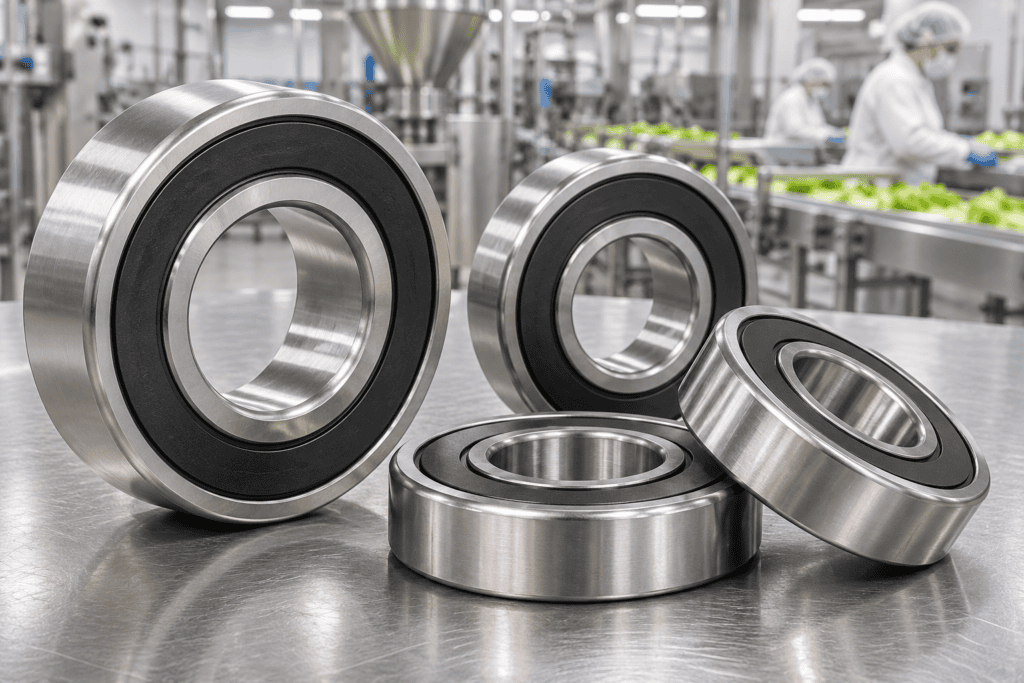
In food plants the bearing almost never fails from food contact itself; it fails because washdown water and cleaning chemicals flush out the grease. That is why sealed 2RS execution matters more than the final digit of the grade. A sealed S6000 2RS in 440C will outlast an open 316 bearing in the same position, because the rubber seals keep the lubricant in place while the 440C raceways handle the radial load of the drive.
A practical specification for food machinery: 440C rings, 2RS seals, food-grade grease where the application involves incidental contact. Reserve 316 rings for equipment that sees chloride-based sanitizers or salt, such as seafood processing or brine handling, and accept the lower load rating by moving up one bore size.
For Medical Devices: Miniature Stainless Bearings
Medical applications rarely load a bearing heavily; they punish it with sterilization, saline, and space constraints. The stainless range includes instrument-sized parts such as the S692 2RS with a 2 mm bore, 6 mm OD, 3 mm width and 57 lbf dynamic load at just 0.35 g, and the inch-series SR09 with a 0.04″ bore and 0.125″ outer diameter rated at 18 lbf dynamic. Both are listed for medical device and laboratory duty, where 316-grade corrosion resistance and non-magnetic behavior often outweigh raw capacity.
One caution from the field: if a device is sterilized in an autoclave with chloride residues, standard 440C can pit. Specify 316 rings for any part that sees repeated autoclave or saline exposure, and verify the cage and ball materials, since a 440C ball in a 316 assembly still introduces a galvanic pair.
Sealed, Shielded, or Open?
Most hygienic applications should default to 2RS rubber seals: they block washdown spray and dust far better than metal shields (ZZ) and eliminate the relubrication intervals that open bearings demand. Open stainless bearings still have a place in instrument and laboratory mechanisms where friction must stay minimal and the assembly itself is sealed.
Bottom Line
For food and medical equipment, the correct default is a 440C stainless bearing in 2RS sealed execution — it is the only one of the three grades that combines real load capacity with corrosion resistance. Step up to 316 specifically when chlorides, saline or aggressive sterilization chemistry are present, and step up one series size (62 to 63) to recover the load capacity you lose with non-hardenable grades. Browse the full stainless steel ball bearing range for available sizes and load ratings.
FAQ
Are 304 and 316 stainless bearings magnetic?
Essentially no — both are austenitic grades and non-magnetic in service. 440C is martensitic and will attract a magnet, which matters in medical imaging or sensor applications.
Can a stainless bearing replace a chrome steel bearing one-for-one on load?
Only with 440C, and even then, expect roughly two-thirds of the dynamic capacity of an equivalent chrome steel part — for example, the S6301 2RS is rated at 8,730 N dynamic. With 304 or 316 rings the capacity drops further because those grades cannot be hardened.
Why did my stainless bearing rust if it is “stainless”?
Usually one of three reasons: the grade was wrong for the chemistry (440C pits in chlorides), the seals allowed washdown fluid in, or the bearing was mounted on a carbon steel shaft that rusted and transferred oxide onto the races. Matching the grade to the actual exposure is the fix.